 YAPPIE
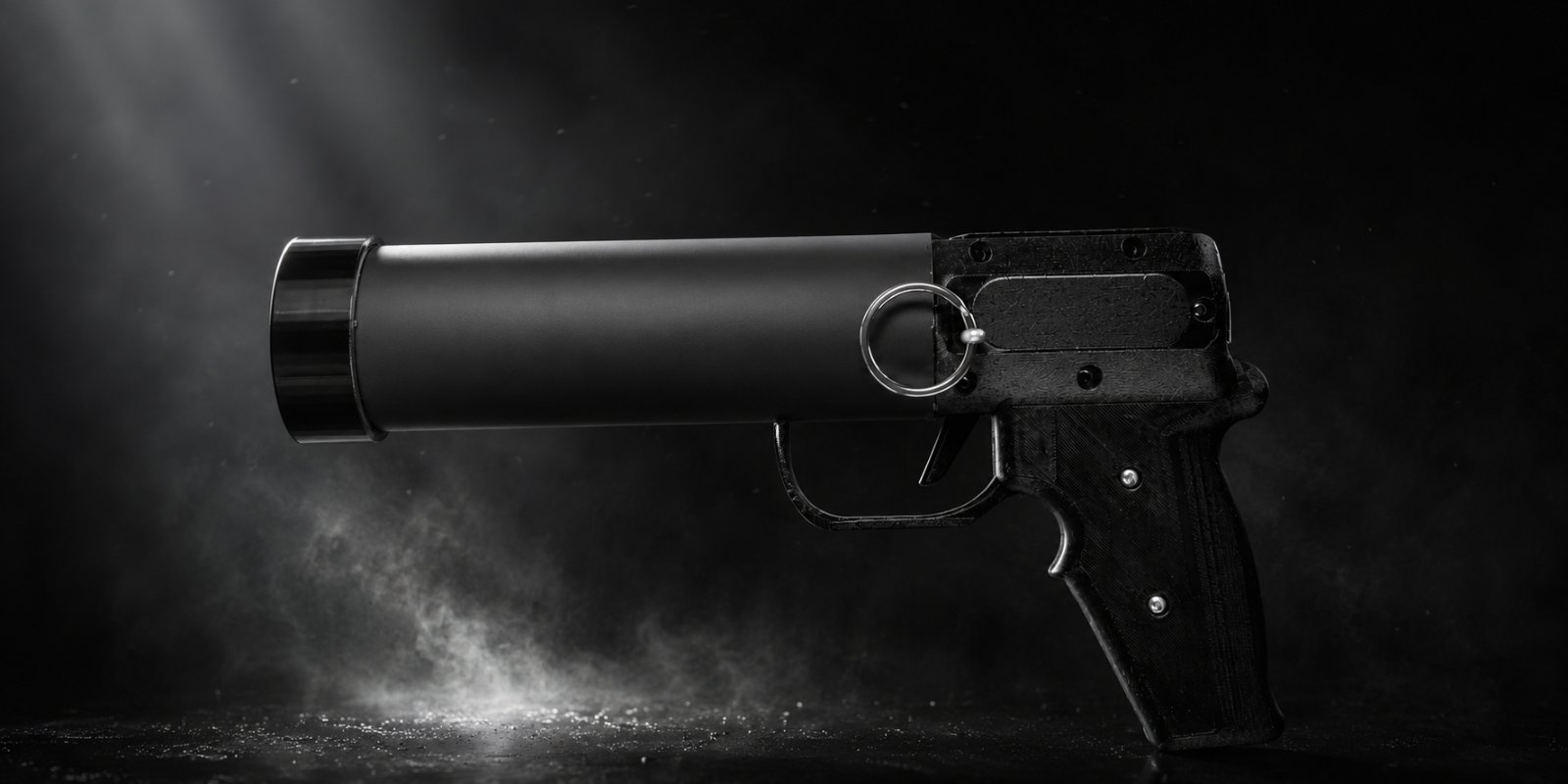
The problem of FPV drones has an unpleasant feature. Electronic warfare works against them, small arms work, detection systems work. But all these means have one thing in common: they are needed in advance. And what to do when the drone is already twenty meters away and flies at you?
It was for this scenario that the Ukrainian company BlueBird Tech made «Chipu».
What is it
«Chip» is a compact device in the form factor of a gun. Shoots not with a bullet, but with a net.
After the trigger is pressed, the pyropatron ejects the net, which opens in the air by about 3 by 3 meters. The mesh entangles the drone's screws, it loses controllability and falls.
Effective distance up to 25 meters. Opening the grid takes 0.2 seconds. Actuation in a few seconds: pull out the fuse, aim, shoot. Disposable device. The light body allows you to carry it as a result, unloading or backpack without a noticeable additional load.
Why a net, not a ball
The logic here is not obvious at first glance, so it is worth analyzing.
High accuracy is not required and this is the main thing. Hitting a maneuverable drone flying at you from a machine gun is a task for a very prepared person in a very calm state. The grid covers the area, not the point. The developers directly emphasize this: a large opening area increases the probability of interception precisely because aiming does not have to be ideal. The line from the machine can be heard far away and shows where you are. A shot with a netcomet - no. Unlike EW tools, «Chip» does not jam anything. This is important because our own communication systems do not suffer from it. The bullet that missed the drone flies on. Grid - no.
The main limitation, which should be said directly
Twenty-five meters is very small. The developers do not hide this and formulate the purpose unambiguously: a tool of the last line of defense. It is needed when the drone is already at a critically close distance and there is practically no time left for other methods of countermeasures. That is, it is not a replacement of EW, not a replacement of detection systems and not a replacement of small arms. This is what remains when everything else has not worked. Understanding this limit is fundamentally important. The device, which is presented as a universal solution to the FPV problem, is disappointing. A device that is honestly positioned as the last chance performs its function.
Who will get it - and why not only the military
Production is not only focused on the Defense Forces. Addressees include journalists, volunteers, critical infrastructure workers and civilians working in dangerous areas.
The company explains this decision directly: the threat from FPV drones does not only apply to the military, the enemy attacks logistics, infrastructure, journalists and volunteers, which is why production was scaled.
And this, unfortunately, is an accurate description of reality. The FPV drone is cheap, and therefore it is used not only against equipment on the front lines. A truck driver with a humanitarian aid, a crew repairing a power line, a film crew - all of them ended up on the list of targets. Previously, this category of people simply did not have any personal protective equipment against the drone. Now he appeared.
What does this say about the state of war
When last-chance anti-drone weapons become a mass-produced commodity of 500 units per month and are sold not only to the military, it means that the threat has ceased to be an exceptional situation and has become a background condition for work in the front-line areas. This is the level at which the countermeasure should be cheap, simple and accessible to everyone who works there. A complex system for tens of thousands of dollars does not solve this problem - you cannot give it to every driver. Therefore, the main value of «Chips» is probably not even in technology. It is that it is a massive and simple tool for a category of people who have had nothing so far.
Sources: BlueBird Tech, Texts.org.ua, LIGA.net, RBC-Ukraine, Word and Deed