 YAPPIE
Choosing a TV seems complicated because of the number of terms on the box, although in reality everything comes down to several consecutive decisions, and each subsequent one narrows the choice. The order matters here, since the size sets the price range even before you think about the brand, while the room lighting determines the type of panel regardless of the budget. Let us go through this sequence and at the same time figure out the labels that mean nothing.
First Decision: Size Based on the Distance to the Sofa
Measure the distance from the place where you sit to the wall where the TV will be. For a typical distance of approximately two and a half meters, a diagonal of sixty-five inches provides the viewing angle that most people consider comfortable. A larger screen does not automatically mean a better experience, since from too close a distance you stop taking in the picture as a whole and start distinguishing the structure of the image. Separately measure the actual installation space and check the full dimensions of the model together with the stand, rather than only the stated diagonal, because the width of the body with the legs often turns out to be greater than expected.
Second Decision: Panel Type Based on Room Lighting
This is the most important technical decision, and it depends not on the budget, but on your room. For a dark room or for a room where you watch mostly in the evening with the curtains closed, OLED gives the best result, since this technology provides true black because the pixels can be switched off completely. For a bright room with large windows, where the TV operates during the day, Mini LED is better suited, since it provides significantly higher brightness and maintains picture readability when sunlight hits the room. For a limited budget or for a secondary room, a regular liquid-crystal panel is quite acceptable. Here it is also worth clearing up the most common confusion. The QLED designation is not a separate competing technology alongside OLED, despite the similarity of the names. It is a layer of quantum dots that is applied over a liquid-crystal or Mini LED panel and expands the color gamut, but does not change the nature of the panel itself. A TV with the QLED label underneath this layer remains a liquid-crystal TV, and the depth of black on it is fundamentally different from that of OLED. Regarding OLED burn-in, it is worth speaking honestly. With varied viewing, the risk is small, but it remains real if you keep a static element on the screen for hours every day, for example a channel logo or news ticker.
Third Decision: Gaming Characteristics, If You Need Them
If the TV is being purchased for a game console or computer, a set of requirements appears here that really matters. An HDMI port version 2.1 with full bandwidth is mandatory, since it is what transmits an image at four times the resolution with a frequency of one hundred and twenty frames. A native refresh rate of one hundred and twenty hertz, rather than a software-emulated one, is needed for the corresponding console modes. Variable refresh rate synchronizes the panel with the console, removing tearing and stuttering when frames drop. Automatic switching to game mode enables the necessary settings without your participation. Input lag below twenty milliseconds is considered good, and below ten excellent. If you do not play games, all these points can be completely ignored, and they are not worth the extra cost.
Fourth Decision: Everything Else Is Mostly Marketing
Now about the labels on the box that do not mean what they seem to. Refresh-rate figures in advertising names such as motion indexes or smoothness indicators are not the actual refresh rate of the panel, since manufacturers invent their own designations in which software processing is added to the physical characteristics. The actual refresh rate should be looked for in the technical specifications, not in the marketing name. Contrast-ratio figures with large numbers cannot be compared between brands, since each measures them in its own way. Eight-kilobyte resolution horizontally has no practical meaning for home viewing, since there is almost no content in such quality, and at a normal distance from the sofa the human eye cannot distinguish the difference from four-times resolution. The same money will give you more if you invest it in a better panel at four-times resolution.
The number of supported high dynamic range formats matters less than the brightness of the panel itself, since a format without sufficient brightness does not provide anything.
About Sound
Built-in speakers are weak in practically all modern TVs, and the reason is simple, since it is impossible to fit a normal acoustic volume into a thin body. The practical conclusion is that with a limited budget it is more sensible to take a cheaper panel and add a soundbar than to buy a more expensive TV and rely on its sound. If a soundbar is planned, check for a port with support for the return audio channel, since this simplifies the connection.
About the Software Platform
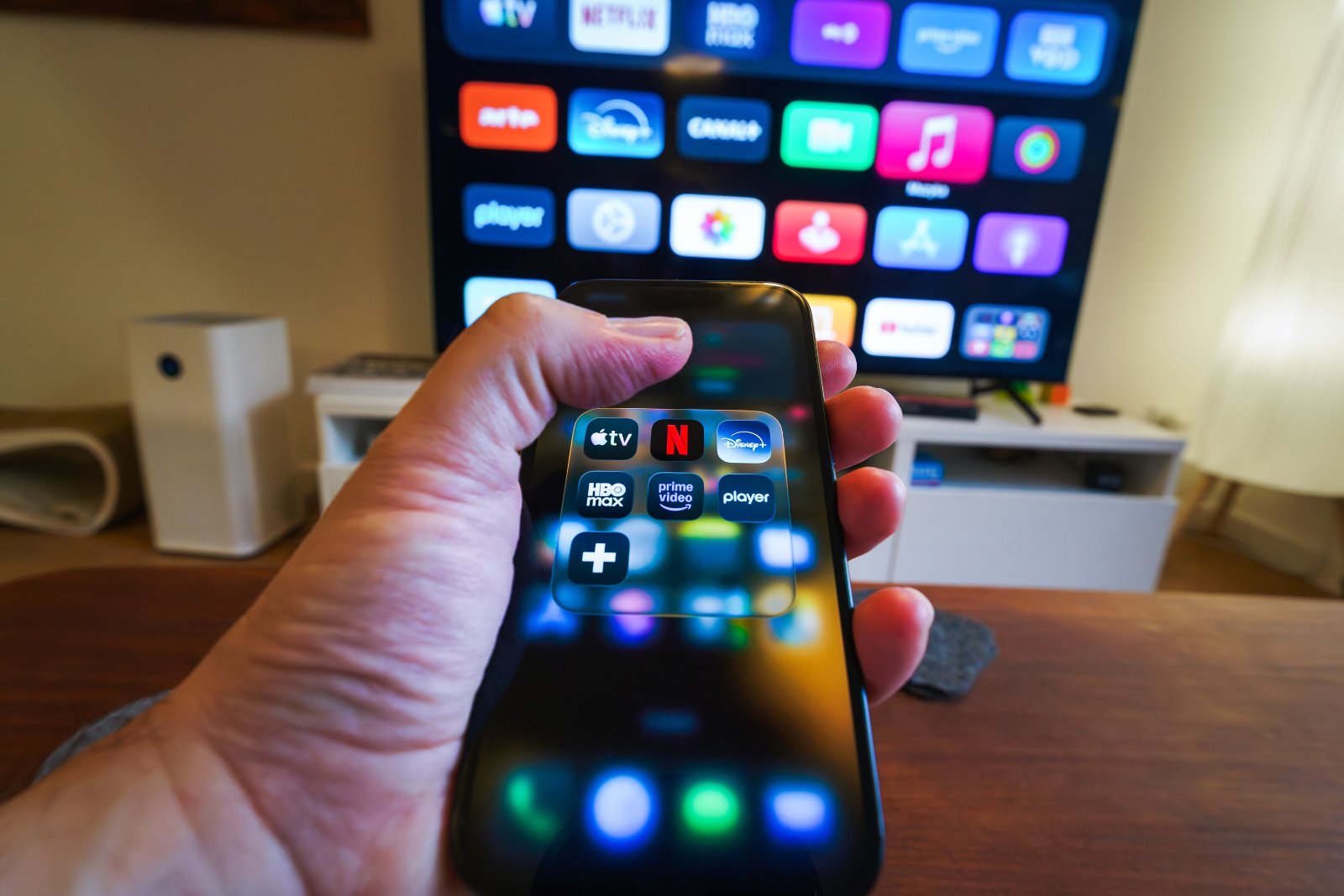
The TV's operating system determines how convenient it is to use every day, and each manufacturer has its own. What is practically more important is not the name of the platform, but the availability of the applications you use. Before buying, it is worth checking whether the application store of the specific platform has the services you watch, including Ukrainian ones. Also keep in mind that platform support ends earlier than the physical service life of the panel, meaning that after several years applications may stop being updated. A workaround is an external streaming device, which costs little and can be replaced separately from the TV.
What to Consider in Ukrainian Conditions
Most of our apartments have bright rooms with large windows, so in our conditions Mini LED turns out to be a more practical choice than OLED more often than follows from foreign reviews.
A TV is a noticeable consumer of electricity, and models with a large diagonal consume from one hundred and fifty watts and above, so during outages it is possible to power it from a power station only for a short time. I wrote separately about choosing energy storage devices. An official warranty and the availability of service are more important than a small difference in price, since repairing a panel imported unofficially may turn out to be impossible. Prices are worth comparing on aggregators, since the difference between stores for the same model can be significant.
Sources: industry guides on choosing TVs for 2026, Tom's Guide materials, manufacturers' technical specifications.